|
 |
|
|
|
|
|
 |
|
Guide map includes satellite image of this area |
|
Francis Barber (Dr Samuel Johnson’s Manservant)
|
|
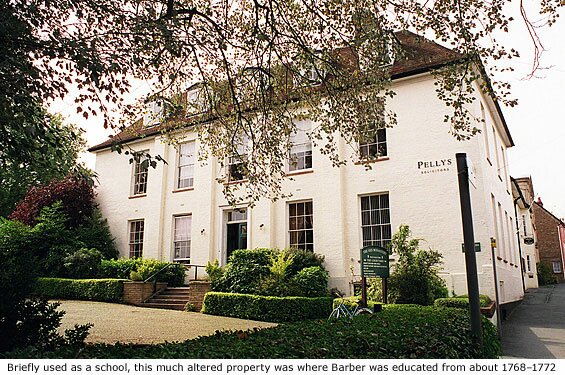
 Three years after the death of Rev Joseph Clapp in December 1767, aged 44 years, the old Grammar school, of which he had been headmaster, was demolished. It had actually fallen into disrepair in 1768, and with no alternative accommodation available, Clapp’s widow, Mary, allowed the school to move into their home, Windhill House. It was here, from approximately 1768 to 1772, that Dr Samuel Johnson (compiler of the first English Dictionary in 1755) sent his West Indian manservant, Francis Barber, to learn Latin and Greek. Three years after the death of Rev Joseph Clapp in December 1767, aged 44 years, the old Grammar school, of which he had been headmaster, was demolished. It had actually fallen into disrepair in 1768, and with no alternative accommodation available, Clapp’s widow, Mary, allowed the school to move into their home, Windhill House. It was here, from approximately 1768 to 1772, that Dr Samuel Johnson (compiler of the first English Dictionary in 1755) sent his West Indian manservant, Francis Barber, to learn Latin and Greek.
It is thought that Johnson perhaps chose Bishop’s Stortford for Barber’s education through his Quaker connections in the town, and is recorded as having said that he enjoyed his walks up Windhill when visiting Barber. His five years of schooling is supposed to have cost Johnson £300, a small fortune at that time, though what the younger pupils thought of this adult West Indian sitting alongside them in class is hard to imagine.
Francis Barber (1735–1801) was born into slavery on a sugar plantation in Jamaica and brought to England as such by the plantation owner in 1750. After a brief education at Barton village school near Darlington in Yorkshire, he then entered the service of his owner’s son, Richard Bathurst, a friend of Dr Johnson. When Johnson’s wife ‘Tetty’ died in 1752, Bathurst sent Barber to work for him as a manservant, but two years later Bathurst’s father died and in his will left Barber £12 and gave him his freedom from slavery.
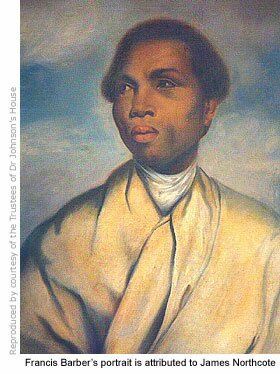
Johnson treated him like a surrogate son, called him Frank instead of Francis and even had his portrait painted (above) by an assistant of the President of the Royal Academy, James Northcote. But Barber was young and high spirited. With his new found freedom he ran away to London and worked as an apothecary’s assistant at Cheapside. He still kept in touch with Johnson but in 1758 joined the Navy and served for two years on HMS Stag, protecting fishermen in the North Sea. When Johnson found out about this, his contacts at the Admiralty soon ensured Barber’s discharge and in 1760 he continued his employment with Johnson.
After his schooling in Bishop’s Stortford, Barber acted not only as Johnson’s valet but also as his secretary and personal assistant. He married an English woman named Elizabeth (also known as Betsy) in 1776 and had four children, the family living with Johnson until his death in 1784. In his will Johnson left him a gold watch, an annuity of £70 and property at Burntwood near Lichfield, which he moved to and later became a teacher in the local school. Sadly, he was unable to manage his finances and when both he and his wife fell destitute he sold the gold watch and other keepsakes given to him by Johnson. Frank Barber died in Stafford Infirmary in 1801. His son (also Samuel) became a primitive Methodist preacher in Staffordshire, and his descendants still live in the area.
Dr Johnson’s House
|
|
|
|
|
|
|
|
|
|
|
Sir Henry Chauncy
|
|
|
|
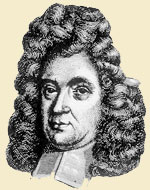 Born 12 April 1632 at Yardley Bury, Yardley, Hertfordshire, Henry Chauncy first attended school at Yardley vicarage. At the age of nine he went to Stevenage Grammar school, where he stayed for five years, and spent just one year at Bishop’s Stortford Grammar school under headmaster Thomas Leigh. Aged fifteen he went to Gonville and Caius College, Cambridge, but left without taking a degree. Regardless of any academic qualifications he was admitted to the Middle Temple, London, in 1650, and was called to the bar in 1656. Born 12 April 1632 at Yardley Bury, Yardley, Hertfordshire, Henry Chauncy first attended school at Yardley vicarage. At the age of nine he went to Stevenage Grammar school, where he stayed for five years, and spent just one year at Bishop’s Stortford Grammar school under headmaster Thomas Leigh. Aged fifteen he went to Gonville and Caius College, Cambridge, but left without taking a degree. Regardless of any academic qualifications he was admitted to the Middle Temple, London, in 1650, and was called to the bar in 1656.
Chauncy went on to hold a number of high positions at law in Hertfordshire, founded Hertford’s Blue Coat School, and was knighted by Charles II in 1681. That same year he inherited his father’s estate, which eventually gave him the opportunity and financial resources to give up the legal profession and compile *The Historical Antiquities of Hertfordshire.
It took him fourteen years to research and a further five years in the press, but it was finally published as a single large volume in 1700, the 500 copies dedicated to its principle sponsor the third earl of Bridgewater. The book was not, however, completed to his original design. Escalating costs and a private legal dispute prevented him from using further material he had gathered, his original intention being to publish it as an appendix and give to readers free of charge. As it turned out, the additional material was freely drawn upon by Nathaniel Salmon for his History of Hertfordshire, published in 1728.
Chauncy is widely credited as Hertfordshire’s greatest historian, and his Antiquities is regarded as the rockbed for all histories of Hertfordshire written before the 20th century. It has subsequently been drawn upon not only by Nathaniel Salmon, but also by 19th century historians, Robert Clutterbuck and J.E. Cussans.
Chauncy gave the following account of Bishop’s Stortford:
‘This town is built in the form of a cross, having four streets pointing east, west, north and south; and is situated in an wholesome and sweet air, on dry soil, on the east side of a hill facing the rising sun; and extends from the upper part of a hill to the River Stort, which encompasseth the castle and divides the town from a street called Hockerill, that extends to the upper part of the opposite hill, and upon the east side of the river was a castle, and St Osyth’s Well, a spring held good for the eyes’.
He also described the school as ‘An excellent nursery that supplied both Universities with a great number of gentlemen who proved eminent in divinity, law and physics, and some matters of State’.
Henry Chauncy married three times and fathered nine children. He maintained his house at Yardley Bury, but also lived at Lombard House, Hertford, where he is said to have written much of Antiquities. He died at Yardley Bury at the end of April 1719 and was buried in the parish church.
*Only 500 copies of the first edition were printed in 1700. A second edition, in two volumes with folding map and 45 engravings, was produced in 1826 by John Morse Mullinger in his print shop at No 18 North Street, Bishop’s Stortford. This version was reprinted in 1975 but is now out of print.
*Additional information taken from the Oxford Dictionary of National Biography
|
|
|
|
|
|
|
|
|
|
[ BACK TO TOP ] |
|
|
|
|